1. Attention Loss: Why You Struggle to Focus
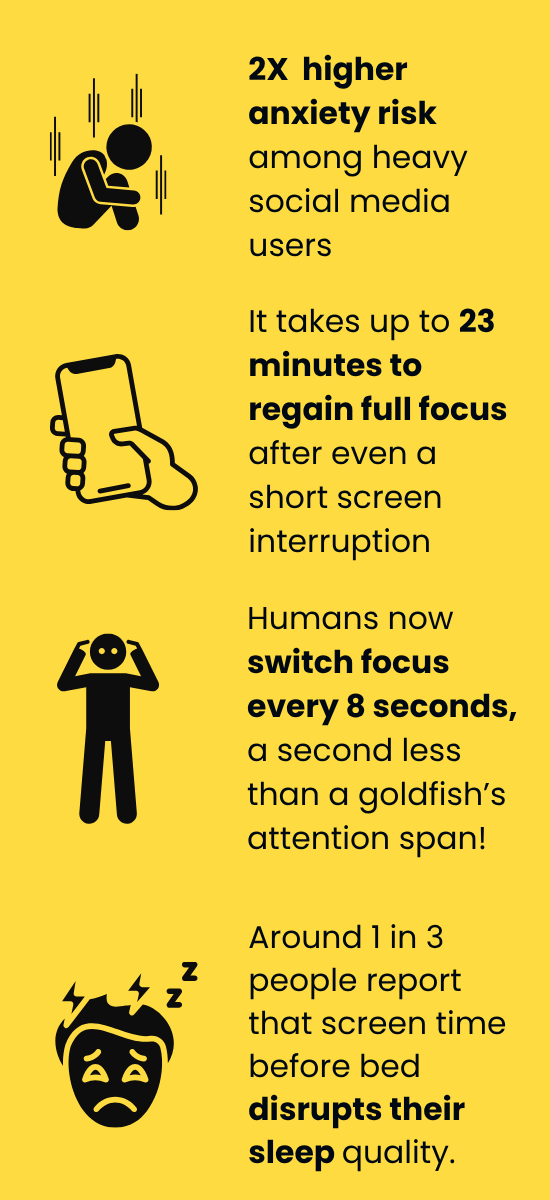
Your brain loves novelty. Each swipe delivers a new image, headline, or sound — a mini dopamine hit. But this constant stimulation fragments your focus. Studies show that after every digital interruption, it can take up to 23 minutes to fully regain concentration (University of California, Irvine).
That means every time you jump from one app to another, your brain resets, like rebooting a computer over and over. The result? Shallow attention, weaker recall, and a growing inability to stay present in real life.
2. Anxiety: The Dopamine Crash Cycle
Social media gives instant gratification. Likes, laughs, updates. But every high comes with a crash. Researchers have found that passive scrolling (endlessly browsing without interacting) is directly linked to higher anxiety and depression scores, especially in young adults (Bournemouth University, 2023).
The brain’s reward system lights up during scrolling, but when you put the phone down, dopamine dips, leaving you feeling restless, uneasy, and oddly empty. It’s the same psychological loop that drives addictive behaviors.
3. Irritable Mood: When Comparison Becomes Contagious
It’s not just the time you lose, it’s the emotions you absorb. Seeing filtered success stories and perfect lifestyles tricks your brain into comparison mode, triggering irritability and low self-worth. According to the American Psychological Association, heavy social media users report 40% higher levels of mood swings and irritability linked to online comparison and overstimulation.
Over time, constant exposure to highlight reels makes ordinary life feel dull, and that imbalance feeds chronic dissatisfaction.